
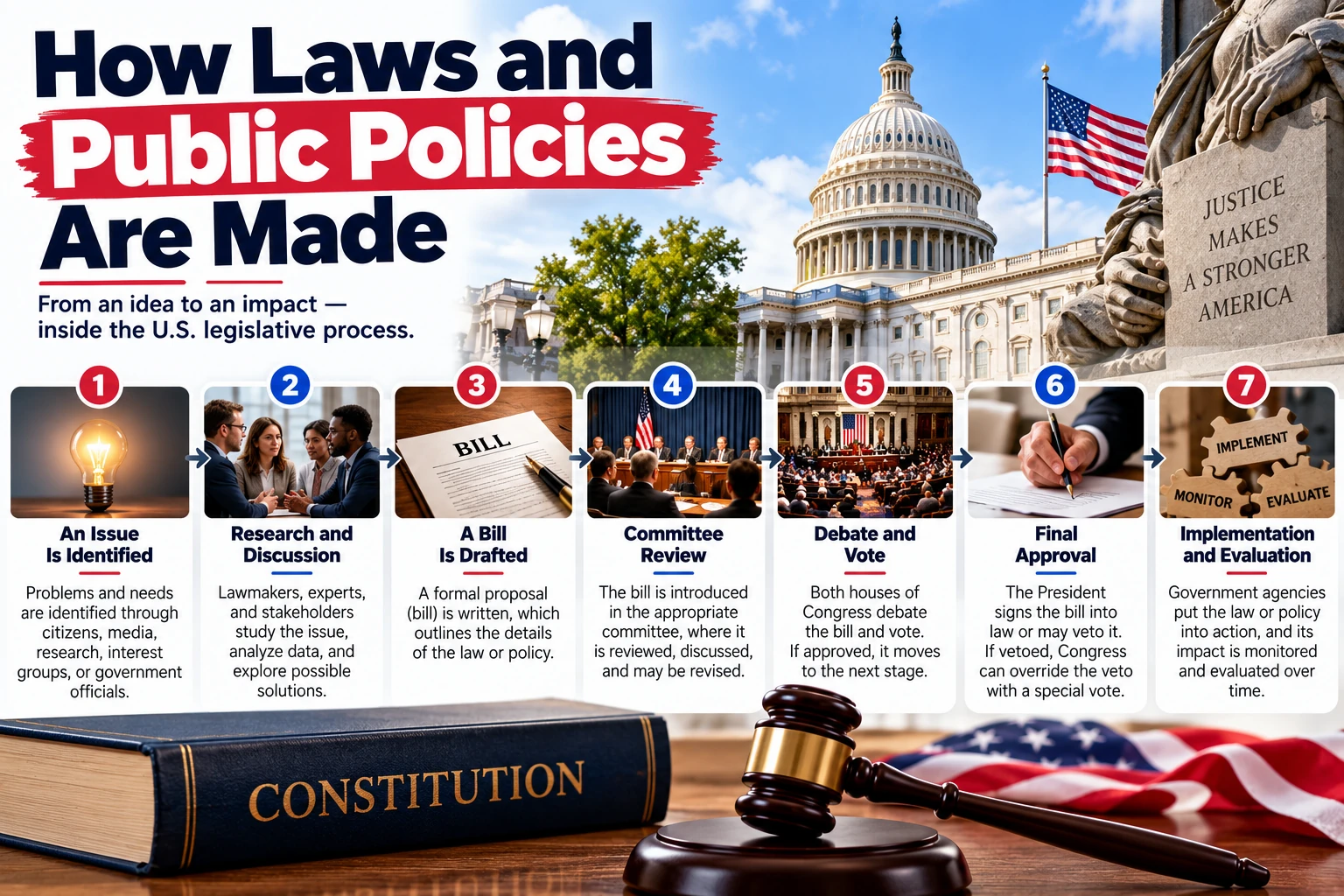
Laws and public policies influence many parts of everyday life, from taxation and education to transportation, business, healthcare, and public safety. Yet the process through which a proposal becomes a law is often less familiar to the general public.
In India, Parliament’s basic legislative function is to make laws, and legislative proposals are introduced in the form of Bills. A Bill is a draft legislative proposal; it becomes an Act after being passed by Parliament and receiving the President’s assent.
What Is a Public Policy?
Public policy is a broader concept than legislation. It refers to the approach taken by a government to address a particular public issue.
A policy may involve programs, administrative decisions, regulations, spending priorities, or legislation. Not every policy requires a new Act of Parliament.
For example, a government may introduce a program using existing legal authority, while another policy objective may require changes to existing legislation.
How a Legislative Idea Develops
A legislative proposal can begin with a perceived public problem, administrative requirement, existing policy objective, or need to change an existing law.
Within government, the relevant administrative ministry may develop the proposal. Parliamentary materials describe a process in which the ministry prepares the broad proposal, legal authorities examine its constitutional and legal aspects, and the proposal can then be developed into draft legislation for consideration.
The drafting process can involve discussions, revisions, and examination of the proposed provisions before a Bill is finalized.
What Is a Bill?
A Bill is essentially a proposed piece of legislation. It is not automatically a law simply because it has been introduced.
In Parliament, Bills can be Government Bills introduced by ministers or Private Members’ Bills introduced by members who are not ministers. Parliament also recognizes different categories of Bills depending on their subject and purpose.
Understanding this distinction is important because public discussion sometimes refers to a proposal as though it were already an enforceable law.
Introduction and Readings
Once a Bill is introduced, it goes through parliamentary stages. According to the Lok Sabha’s explanation of the legislative process, a Bill is considered through three stages in each House.
The first stage involves its introduction. During the second stage, the House can consider the Bill, refer it to a Select or Joint Committee, or circulate it for eliciting opinion, followed by detailed consideration of its clauses. The third stage focuses on whether the Bill should be passed.
This process provides opportunities for parliamentary examination and debate.
The Role of Parliamentary Committees
Committees can play an important role in examining legislation. Depending on the Bill and parliamentary procedure, a proposal may be referred to a Select Committee or Joint Committee.
Committees can examine the general principles and individual clauses of Bills referred to them and present reports.
Committee examination can therefore provide an additional stage of detailed consideration beyond debate in the full House.
Approval by Parliament
For an ordinary Bill, parliamentary approval involves both the Lok Sabha and Rajya Sabha. After the required parliamentary stages are completed, the Bill is presented to the President for assent.
The official parliamentary explanation states that a Bill cannot become law unless it receives approval from both Houses and the President’s assent, subject to the constitutional procedures applicable to the particular type of Bill.
Money Bills have specific constitutional procedures, including restrictions concerning their introduction and the role of the Rajya Sabha.
From Bill to Act
Once the necessary parliamentary approval and presidential assent have been obtained, the Bill becomes an Act. The legislation can then take effect according to its commencement provisions and applicable notifications.
Some Acts authorize the government or relevant authorities to make rules, regulations, or notifications for implementing the legislation. The Legislative Department notes that subordinate legislation can include statutory rules, orders, and notifications issued under an Act.
This means that understanding an Act may sometimes require looking at the rules and notifications made under it as well.
Why Public Understanding Matters
Understanding how laws are made can help citizens evaluate information more carefully. A proposal announced by a government is not necessarily an enacted law. Similarly, a Bill introduced in Parliament may still be debated, amended, referred to a committee, or rejected.
The official Digital Sansad database provides information about Bills, including their introduction dates, parliamentary status, committee referrals, passage, and assent.
Following these stages can help people distinguish confirmed legal changes from proposals or political discussion.
Staying Informed
Citizens can follow parliamentary websites, government notifications, official legislation databases, and credible reporting to understand changes in public policy and law.
When reading about a proposed law, check its current status and the source of the information. It is also useful to identify whether a statement refers to an announcement, Bill, Act, rule, or policy.
The law-making process involves multiple stages designed to provide opportunities for consideration and parliamentary action. Understanding those stages makes it easier to follow public affairs, interpret government announcements accurately, and participate in civic discussions with a clearer understanding of how laws and policies actually develop.